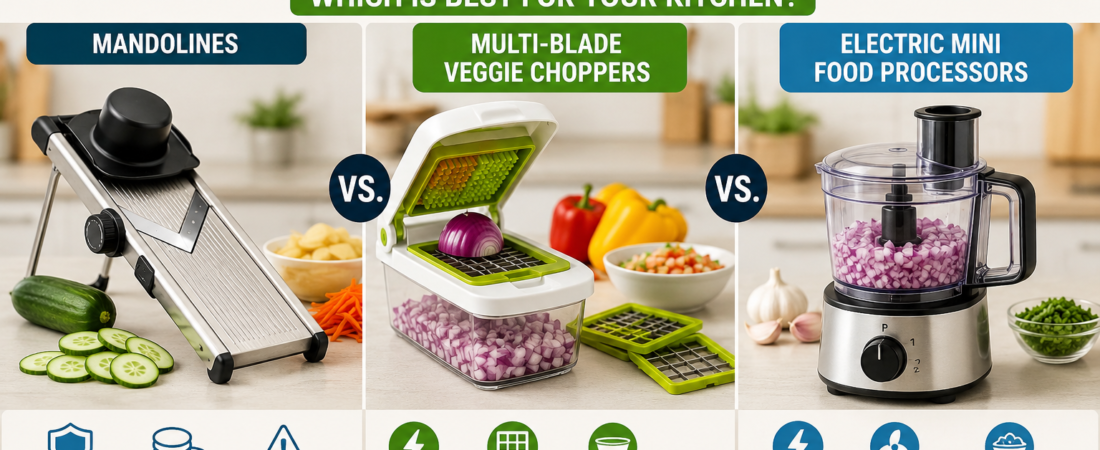
If you’re trying to speed up vegetable prep, three tools tend to come up: mandoline slicers, multi-blade veggie choppers, and electric mini food processors. They can all reduce cutting time, but they solve different problems. A mandoline is the specialist for thin, uniform slices; a multi-blade chopper is better for quick manual dicing; and a mini food processor is the most versatile when chopping, mincing, or making small batches.
Quick Verdict
For most everyday vegetable prep, a multi-blade veggie chopper is the easiest middle ground. It can quickly handle onions, peppers, and similar ingredients without the learning curve or exposed blade of a mandoline. Choose a mandoline when perfectly even slices matter most, while an electric mini food processor makes more sense when you also want to mince herbs, garlic, nuts, or prepare sauces and dips.
Mandoline Slicers: Best for Precise Slices
A mandoline is the specialist of this group. Its main advantage is consistency: you can produce thin, evenly sized slices much faster than with a knife. That’s particularly useful for potatoes, cucumbers, cabbage, radishes, apples, and similar ingredients. Independent testing has found that good mandolines can also offer julienne, matchstick, waffle, and other specialty cuts.
The drawback is safety. A mandoline has a very sharp exposed blade, and your hand moves toward it during use. Testers consistently emphasize using the supplied hand guard, while some recommend cut-resistant gloves as an additional precaution. A dull blade can actually make things worse because it requires more force and reduces control.
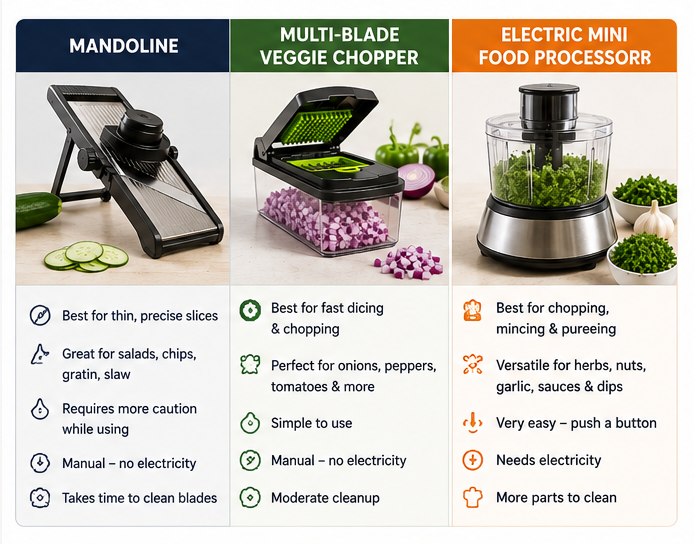
Best for: Thin slices, gratins, salads, slaw, chips, and precise presentation.
Main weakness: Safety and cleanup require more attention.
Multi-Blade Veggie Choppers: Best for Fast Manual Prep
A multi-blade veggie chopper takes a different approach. Instead of sliding food across a blade, you usually press or push vegetables through a cutting grid. That makes it particularly convenient for tasks such as dicing onions, tomatoes, peppers, or potatoes.
The biggest advantage is simplicity. You don’t need electricity, there’s no motor to maintain, and many models collect the chopped food directly in a container. Recent testing and reviews of vegetable choppers show why this design remains popular: the right chopper can significantly reduce repetitive prep work while keeping the cutting process relatively straightforward.
There is a trade-off, though. Dense vegetables can require considerable pressure, and the cutting grids can be more annoying to clean when food becomes lodged between the blades. A multi-blade chopper also doesn’t generally match a good mandoline for very thin, uniform slices.
Best for: Dicing onions, peppers, tomatoes, and everyday meal prep.
Main weakness: Less versatile for precision slicing and dense vegetables can require effort.
Electric Mini Food Processors: Best for Versatility
An electric mini food processor is the most versatile option of the three. Instead of manually pushing food through a blade, you add ingredients to a bowl and let the motor do the work.
That’s particularly useful when you need finely chopped onions, garlic, herbs, nuts, or small batches of ingredients. Depending on the model, a mini processor can also handle tasks beyond basic vegetable preparation.
The compromise is that it introduces another appliance to your kitchen. You have a motor, bowl, blade assembly, cord or battery, and more parts to clean. You also have less control over the exact shape of the finished vegetables. A few pulses might leave you with a rough chop, while longer processing can quickly turn softer ingredients into something closer to a paste.
Compact electric processors are nevertheless attractive for smaller kitchens because they take considerably less space than a full-size food processor.
Best for: Chopping, mincing, herbs, garlic, nuts, sauces, and small batches.
Main weakness: More parts to clean and less precise control over the final cut.
Which One Should You Buy?
| Feature | Mandoline | Multi-Blade Chopper | Mini Food Processor |
|---|---|---|---|
| Thin slices | Excellent | Fair | Poor |
| Even dicing | Fair | Excellent | Good |
| Mincing | Poor | Fair | Excellent |
| Julienne | Excellent on suitable models | Limited | Poor |
| Speed | Excellent | Excellent | Excellent |
| Manual effort | Low | Medium | Very low |
| Safety | Requires extra care | Generally simpler | Generally simpler |
| Cleanup | Moderate | Moderate | Moderate |
| Electricity | No | No | Yes |
| Best overall use | Precision slicing | Everyday chopping | Versatile prep |
The Real Difference Is the Type of Cut
The easiest way to choose is to ignore the marketing and ask what you actually want the vegetables to look like.
If you want paper-thin cucumber slices or uniform potato slices, a mandoline is difficult to beat. Professional product testing confirms that this is where mandolines excel.
If you’re mainly chopping onions and peppers for soups, stir-fries, salads, or meal prep, a multi-blade chopper is probably more practical.
If your preparation involves minced garlic, herbs, nuts, sauces, dips, or finely chopped vegetables, an electric mini food processor offers the widest range of uses.
Final Verdict
There isn’t one winner for every kitchen.
Choose a mandoline if precision slicing is your priority.
Choose a multi-blade veggie chopper if you want fast, simple everyday dicing.
Choose an electric mini food processor if versatility matters more than perfectly shaped pieces.
For the average home cook who mainly wants to reduce the time spent chopping vegetables, I’d lean toward a multi-blade veggie chopper. It occupies a useful middle ground: faster than a knife, simpler than an electric appliance, and less specialized than a mandoline.
Overall recommendation:
🥇 Multi-blade veggie chopper — Best for everyday chopping
🥈 Electric mini food processor — Best for versatility
🥉 Mandoline — Best for precision slicing
The one exception is important: if you’re regularly making thin potato slices, cucumber ribbons, slaw, or other precisely sliced dishes, the mandoline moves straight to the top—but use its safety guard every time. Independent testers consistently identify hand protection as one of the most important considerations with this type of tool.
Affiliate Disclosure: This comparison may contain affiliate links. If you purchase through them, we may earn a commission at no extra cost to you. As an Amazon Associate, we earn from qualifying purchases.